
- August 18, 2026|
- News
Roof lantern leaks around a vent almost always trace back to one design decision, not a fitting error or a bad batch of sealant. Traditional roofing ventilation sits proud of the glazing, and every raised joint becomes a place for wind-driven rain to find a way in.
SheerVent, the flush roof vent built for the S1 Roof Lantern, removes that weak point rather than trying to seal around it.
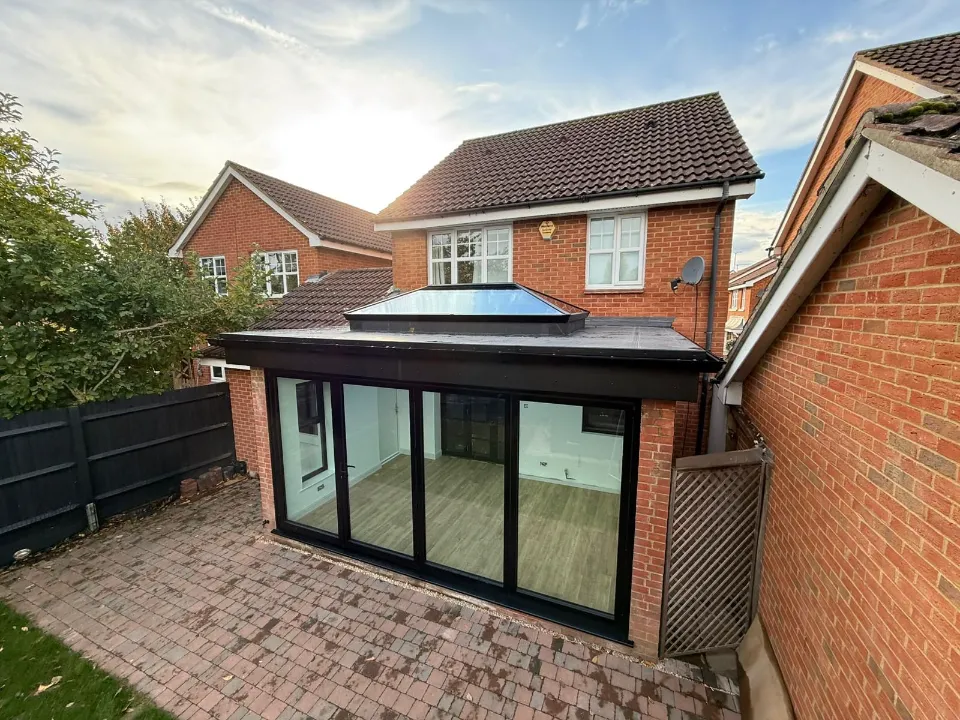
Why do traditional roof lanterns leak around vents?
Most roof ventilation systems on an aluminium lantern are bolted on top rather than built in. That approach brings extra joints, a raised profile and muntin bars, the junction between fixed glazing and the opening vent. Every one of those junctions is a potential ingress point, letting water and moisture track down into the frame below.
Muntin bars are the recurring fault line
A tile ventilator suits a pitched roof with proper eaves and ridge vents doing the bulk of the work, letting hot air escape at the top while cool air is drawn in lower down. Drop one onto a premium aluminium lantern and installers are left managing a leak-prone compromise on a roof that was meant to be flush.
For fabricators and installers, this creates a recurring callback problem that almost always traces back to the same design weakness.
How SheerVent removes the leak risk entirely
SheerVent has no muntin bars. The vent sits level with the S1’s discreet rafter bars, so the finished roof space presents one continuous plane rather than a stepped profile catching rain at the edges of the roof.
| Traditional vent weakness | SheerVent solution |
|---|---|
| Muntin bars create leak-prone joints | No muntin bars – vent integrates into rafter profiles.
Vent integrates into the concealed baffle in the ridge. Vent glazing runs over the eaves-beam. |
| Different glazing spec to main roof | Same 28mm high-performance units throughout |
| Thermal bridging at vent frame | Full thermal break matching S1 standard |
| Manual operation left open in rain | Rain-sensor automation closes vent automatically |
When closed, the vent is almost invisible. This means no visible profile break and no step in the glazing line.

28mm glazing keeps the thermal line unbroken
SheerVent uses the same 28mm glazing as the S1 so thermal performance stays consistent across the whole roof to help save on energy costs. The fully thermally broken frame means no cold bridging at the vent junction.
Rain-sensor and remote-control functionality
SheerVent supports wired actuators, remote controls and optional weather sensors. Rain detection closes the vent without any input from the homeowner. All the automation hardware sits hidden within the profile, so nothing disrupts the roof line or the flow of air through the lantern.
Specify flush roof ventilation on your next S1 project
SheerVent can be retrofitted to compatible S1 installations with minimal disruption. Contact the Sheerline Bespoke team to explore SheerVent and the S1 Roof Lantern.